
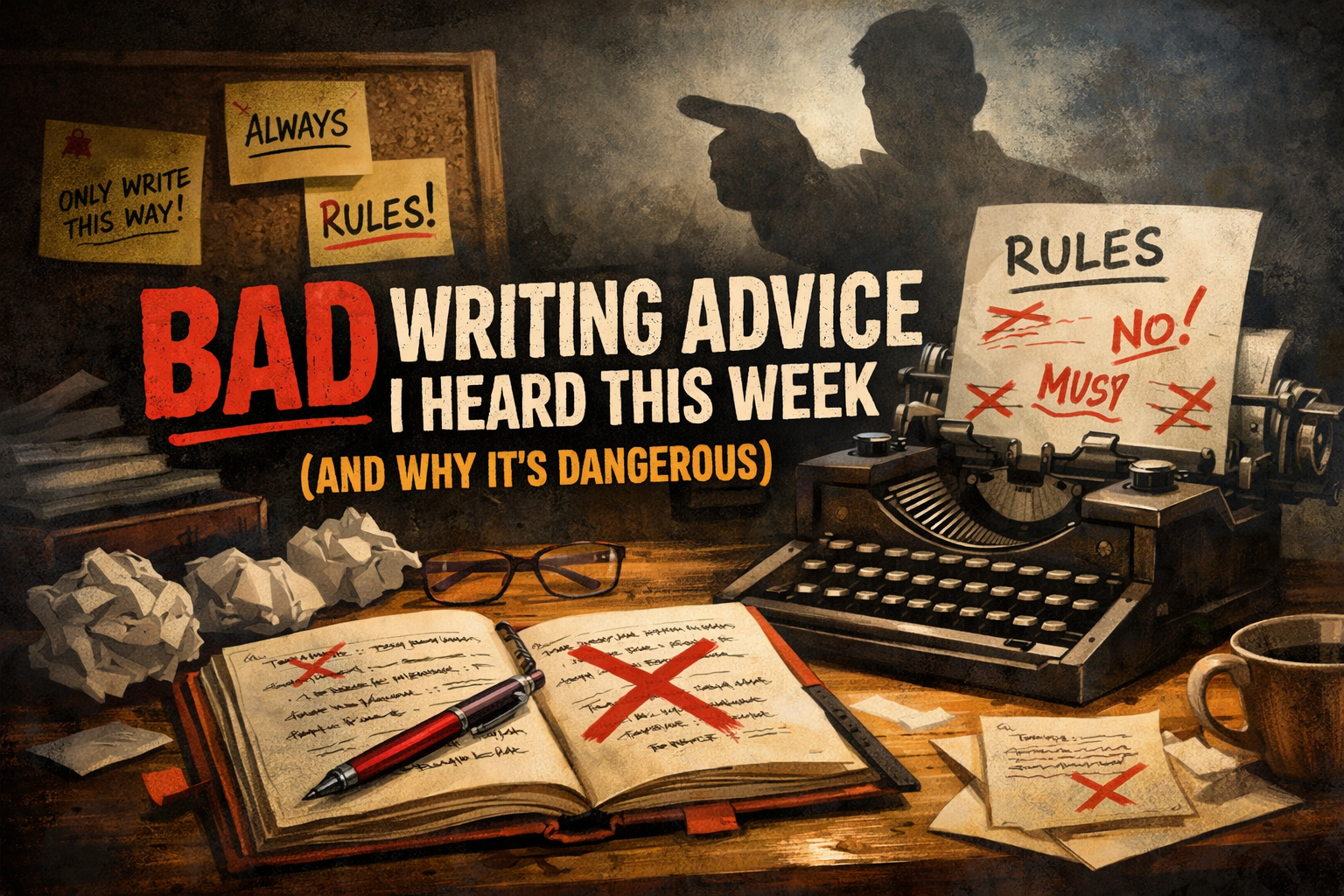
There must be something in the water this week, because the sheer volume of “writing rules” I’ve heard lately has gone from helpful to borderline absurd. I’m talking about the kind of advice that doesn’t just guide craft—it tries to box it in, shrink it down, and make it safe. And the more I listened, the more I realized something important: not all writing advice is created to help you write better. Some of it is designed—intentionally or not—to make you write smaller.
In just a few days, I’ve heard that books must be priced a certain way or they won’t sell, that characters can’t appear too early or too late in a story, that specific story beats must happen on exact pages, and that if you deviate from these “standards,” you’re setting yourself up to fail. The stuff boarders on overthinkging rather than writing. On the surface, a lot of this sounds reasonable. After all, structure matters. Market awareness matters. Craft absolutely matters. But there’s a line where guidance turns into control, and a lot of what’s being passed around right now is crossing that line.
Here’s the truth most people won’t say out loud: rules in writing are often just patterns that worked for someone else, in a specific context, at a specific time. When those patterns get repeated enough, they start to sound like universal laws. They’re not. They’re tools. And tools are only useful if you know when to use them—and when to put them down.
Take pricing advice, for example. There are entire threads and conversations built around what a book “should” cost, as if readers across all genres, audiences, and platforms behave the same way. That kind of thinking ignores one key reality: value is perceived differently depending on the experience you create. A short story priced correctly for one audience might feel like a steal, while the same price point could feel like a ripoff somewhere else. The advice isn’t useless, but it becomes dangerous when it’s presented as the only right answer.
The same goes for character rules. I’ve heard people say a character must be introduced by a certain point or the story will fail. Others insist that readers won’t connect unless specific emotional beats happen in a prescribed order. These ideas come from patterns observed in successful stories, but they ignore something fundamental about storytelling: readers connect to clarity, purpose, and emotional truth, not a checklist. You can break every structural expectation in the book and still create something powerful if you understand why your choices work.
And that’s where most bad writing advice falls apart. It focuses on the “what” without explaining the “why.” It tells you what to do but not what problem it’s trying to solve. Without that context, you’re not learning—you’re copying. And copying might get you something functional, but it won’t get you something that feels like yours.
There’s also a quieter issue underneath all of this, and it’s one worth paying attention to. Some advice doesn’t just aim to improve your writing; it aims to shape your behavior. It tells you what kind of stories are acceptable, what kind of characters are allowed, and what kind of risks are “too much.” It frames creativity as something that needs to be managed instead of explored. And if you’re not careful, you start making decisions not because they serve the story, but because they align with someone else’s expectations.
That’s not writing. That’s compliance.
Good writing advice expands your options. It gives you more ways to solve problems, more tools to express ideas, and more clarity about what you’re trying to achieve. It helps you see your work more clearly without taking control of it. Bad writing advice does the opposite. It narrows your options, replaces your instincts with someone else’s preferences, and makes you second-guess decisions that might actually be working.
So how do you tell the difference? Start by asking a simple question: does this advice help me understand my story better, or does it make me feel like I need to change it to fit a mold? If it’s the first, it’s probably worth exploring. If it’s the second, you need to pause and take a step back.
Another good filter is whether the advice explains consequences. Useful guidance doesn’t just tell you what to do—it tells you what happens if you don’t. It gives you context, trade-offs, and reasoning. It treats you like someone capable of making decisions, not someone who needs to follow instructions. When that context is missing, what you’re getting isn’t insight—it’s imitation dressed up as expertise.
And then there’s experience. Advice grounded in real, practical experience tends to be flexible. It acknowledges exceptions. It leaves room for variation. Advice that sounds absolute—words like “always,” “never,” and “must”—should raise a flag. Writing is too complex, too human, and too varied for hard rules to apply across the board.
None of this means you should ignore structure, market realities, or craft principles. Those things matter. They’re part of what allows your work to connect with readers in the first place. But they’re not cages. They’re frameworks. And frameworks are meant to support your work, not define it.
At the end of the day, you’re the one responsible for the story you’re telling. You’re the one who has to decide what belongs and what doesn’t. That responsibility can feel heavy, especially when you’re surrounded by loud, confident voices telling you what you “should” be doing. But it’s also where your strength as a writer comes from. The ability to take in information, evaluate it, and decide what actually serves your work is one of the most important skills you can develop.
Because if you hand that responsibility off to every new rule that comes your way, you don’t just lose control of your story—you lose your voice.
And that’s not a trade worth making.
So here’s what I want to know. What’s the wildest, most head-scratching writing rule you’ve heard lately? The kind that made you stop and think, “Who decided this was a law?” Share it. I’m genuinely curious, and chances are, you’re not the only one who’s heard it.